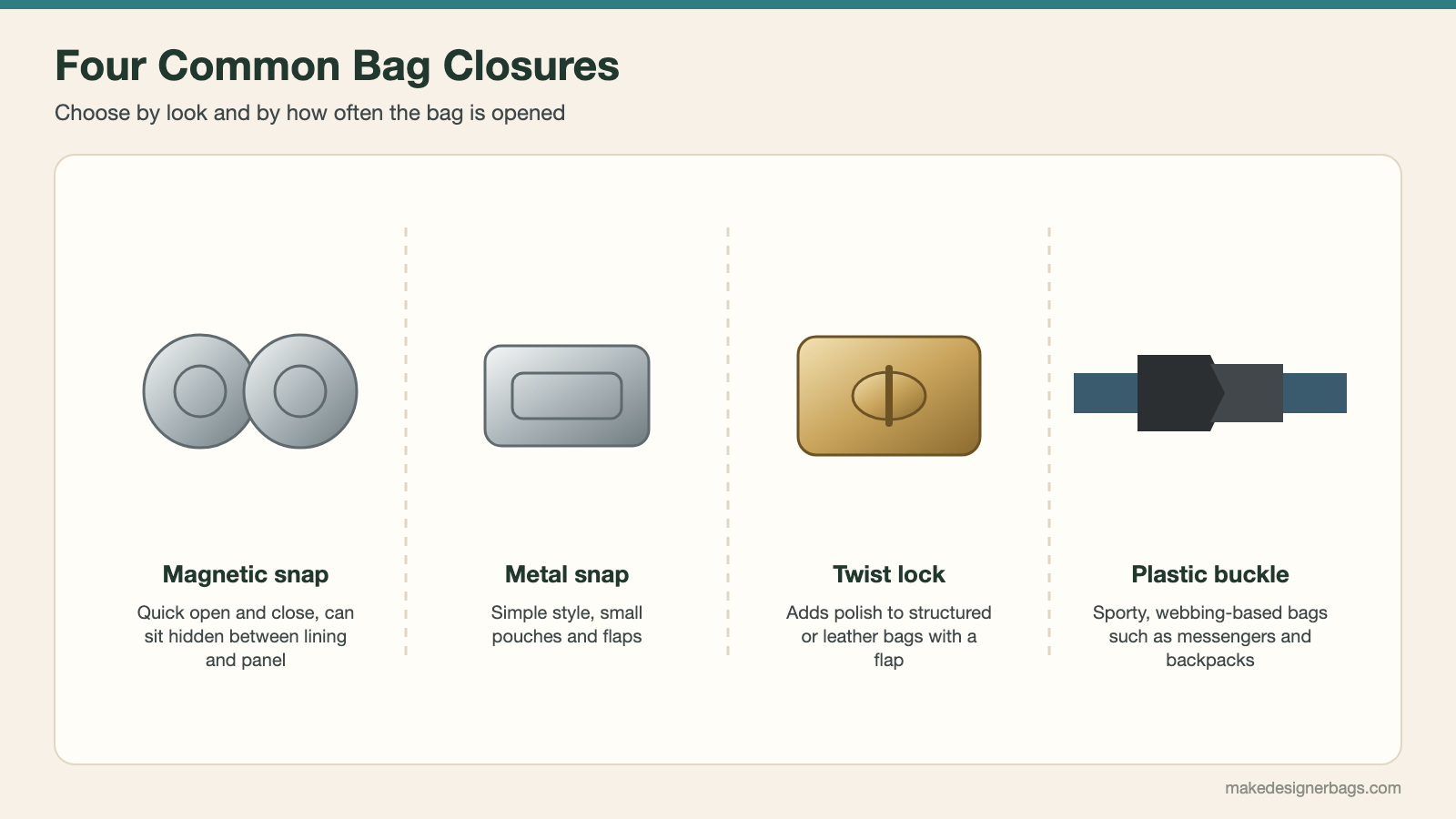
The four common bag closures are the magnetic snap, the metal snap, the twist lock and the plastic buckle. Choose by look and by use: a metal snap suits a simple style, a twist lock adds polish to a structured or leather bag, and a plastic buckle suits a sporty, webbing-based bag you open and adjust often. Whichever you choose, mark both parts precisely and fasten them firmly.
Bag Closure Types Compared
| Closure | Best for | How it is attached |
|---|---|---|
| Magnetic snap | Quick opening; can sit between lining and panel or under a flap | Teeth through two small holes, shim on, teeth bent flat |
| Metal snap | Simple style, small pouches and flaps | Holes punched for both parts, teeth inserted and hammered flat |
| Twist lock | Structured or leather bags with a flap | One part with clips bent flat, the other screwed into a cut oval |
| Plastic buckle | Messenger bags, backpacks and other sporty designs | A piece of webbing on the upper and the lower part of the bag |
Magnetic Snap
A magnetic snap has two teeth on the back. You punch two small holes, push the teeth through, add the shim and bend the teeth flat, then enclose it between two strips that are stitched into the bag. It can sit at the top of a bag between the lining and the outer panel, or under a flap.
Metal Snap
A small metal snap closes with a part on the flap and a counterpart on the bag. Mark the center on the flap, mark the holes through the closure, punch them with the smallest setting and push the teeth through. Press them toward the center with your fingers, then flatten them with a hammer. For the counterpart, decide where the flap should close, press the closure on so the teeth leave an imprint, punch and fasten the same way. Put a piece of leather or another soft surface underneath so the metal does not get scratched.
Twist Lock
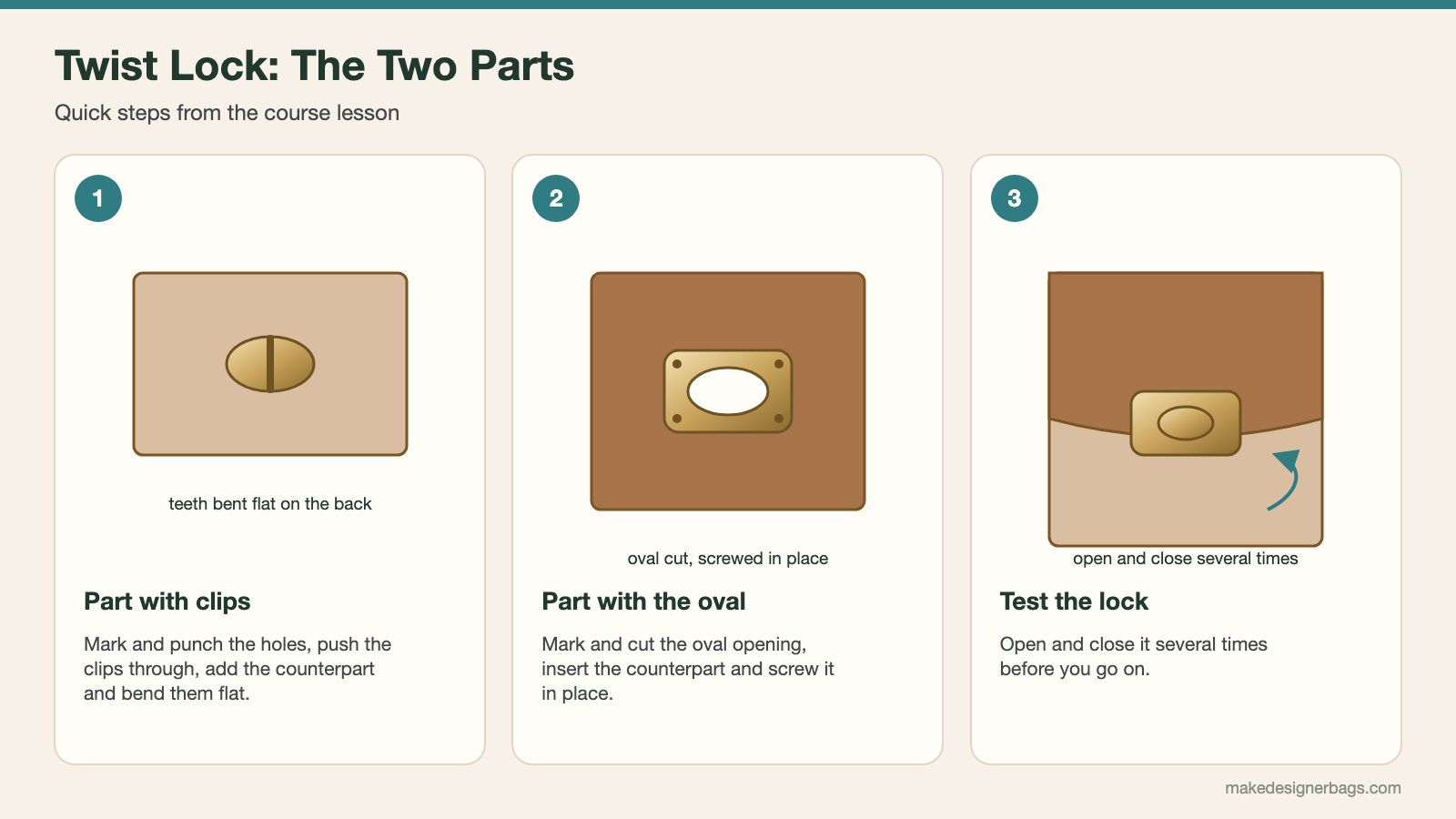
A twist lock, also called a turn lock, is a higher quality closure that adds polish. One part is held by clips or teeth that go through the material and are bent flat on the back. The other part sits in an oval opening that you mark and cut, and is screwed in place. When it is in, open and close it several times to make sure it fastens smoothly.
Plastic Buckle
A plastic snap buckle looks great on a messenger bag or a backpack. Each half needs a piece of webbing the same width as the buckle: one is attached to the upper part of the bag, usually the flap, and one to the lower part.
How to Choose
For a simple style, a metal snap is enough.
For a structured or leather bag with a flap, a twist lock adds polish.
For a sporty, webbing-based bag that is opened and adjusted often, use a plastic buckle.
For a quick, hidden closure at the top of a bag, use a magnetic snap.
Open and close a twist lock several times after installing it, to make sure it fastens smoothly and securely before you consider the job finished.
Common Mistakes
If the two parts do not line up, the closure will not snap, twist or meet properly.
Teeth and clips that are not bent and hammered flat let the closure catch or come loose.
A plastic buckle on a formal leather bag looks out of place. Match the closure to the bag.
Closures are part of what makes a bag look finished; read what makes your handmade bag look elegant and luxurious.
See It on Video
Each of these closures is shown step by step in close-up video in the Bag Sewing Fundamentals course. See the bag making courses.
Frequently Asked Questions
What are the main types of bag closures?
The magnetic snap, the metal snap, the twist lock and the plastic buckle are the four common bag closures.
Which closure is best for a leather bag?
Twist locks and metal snaps suit structured or leather bags. A plastic buckle would look out of place on a formal leather bag.
Which closure is best for a backpack or messenger bag?
A plastic buckle on webbing suits sporty designs like messenger bags and backpacks, and bags you open and adjust often.
Why does my bag closure not close properly?
Usually the counterpart is misaligned, or the teeth or clips were not bent flat. Mark both parts precisely and test the closure after installing it.